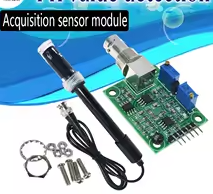
Liquid pH 0-14 Value Detection Regulator Sensor Module
High-Precision pH Meter for Arduino and Water Quality Monitoring
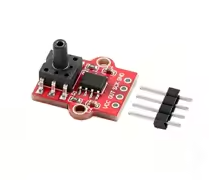
This pH sensor module is a high-performance tool for measuring the acidity or alkalinity (pH) of aqueous solutions [citation:13]. It provides a complete solution for water quality monitoring, hydroponics, and aquarium control projects, delivering reliable analog output for seamless integration with microcontrollers [citation:15].
Measures full pH 014 range Suitable for a wide range of liquids from acidic to alkaline [citation:1].
Easy integration with Arduino and ESP32 - Analog output connects directly to analog input pins [citation:9].
Operating voltage: 5±0.2V DC with 5-10mA current [citation:8].
Output: Analog voltage signal (0-5V) proportional to pH value [citation:13].
Regular calibration using standard buffer solutions (pH 4.0, 7.0, 10.0) ensures accurate readings [citation:4].
The pH probe's glass bulb is fragile - avoid contact with hard objects [citation:4].
Technical Specifications
| Parameter | Value [citation:8] |
|---|
| :- | :- |
| Detection Range | pH 0-14 |
| Operating Voltage | 5 ± 0.2V DC |
| Operating Current | 5-10mA |
| Temperature Range (Probe) | 0-80°C |
| Response Time | ≤ 5 seconds |
| Stability Time | ≤ 60 seconds |
| Power Consumption | ≤ 0.5W |
| Module Size | 42mm x 32mm x 20mm |
## Key Features
+Accurate pH value detection from 0 to 14 in various liquids [citation:1]
+Analog signal output suitable for Arduino, ESP32, and Raspberry Pi [citation:2]
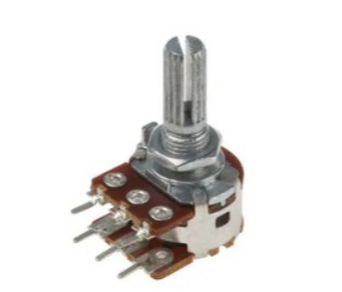
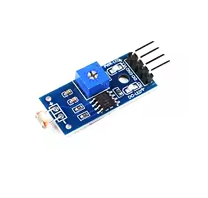
+Onboard potentiometer for calibration adjustment [citation:8]
+LED power indicator and BNC connector for pH probe [citation:9]
+Compact design with 4 M3 mounting holes for easy installation [citation:15]
+Fast response time under 5 seconds for efficient monitoring [citation:15]
= Applications =
- Water quality monitoring and analysis systems [citation:15]
- Aquarium and hydroponic pH control [citation:2]
- Environmental and laboratory research [citation:14]
- Industrial process monitoring [citation:15]
- Educational electronics experiments
Durable and Reliable Designed for longterm use in various monitoring setups [citation:3].
UserFriendly Setup Simple connection and calibration process suitable for beginners and professionals [citation:13].
√ Includes pH electrode probe with BNC interface for easy connection [citation:10].
√ Compatible with Arduino IDE and DFRobot_PH library for quick integration [citation:4].
√ Temperature compensation possible when paired with a temperature sensor [citation:2].
Calibration Instructions
For first use or after extended periods, calibration is essential [citation:4]:
- Prepare standard buffer solutions (pH 4.0 and pH 7.0) [citation:4].
- Upload the sample code to your Arduino board [citation:4].
- Wash the probe with distilled water and gently dry it [citation:4].
- Insert the probe into pH 7.0 buffer, stir gently, wait for values to stabilize.
- In Serial Monitor, enter
enterph to enter calibration mode [citation:4]. - Enter
calph to start calibration - the program automatically identifies the buffer [citation:4]. - Enter
exitph to save parameters and exit calibration mode [citation:4]. - Repeat steps 3-7 with pH 4.0 buffer for second calibration point [citation:4].
After completing two-point calibration, the sensor is ready for accurate measurements [citation:4].
Calibration saves to the EEPROM, so it persists across power cycles [citation:4].
Troubleshooting
Inaccurate readings:
- Wash the probe with distilled water between measurements to prevent cross-contamination [citation:4].
- Ensure the BNC connector and signal board remain clean and dry [citation:4].
- Recalibrate using fresh buffer solutions [citation:14].
Slow response or unstable readings:
- Check for debris on the glass bulb [citation:4].
- The probe may need rehydration - soak in storage solution or pH 4.0 buffer for several hours [citation:13].
- If the probe dries out, soak it in 3M KCl solution for 8 hours [citation:4].