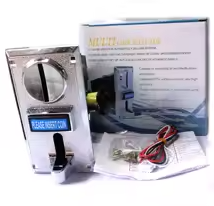
Multi Coin Slot Acceptor Electronic Token Selector Mechanism
Electronic Coin Selector for Arcade and Vending Machines
The multicoin slot acceptor is an electronic token selector mechanism designed for claw crane arcade games, ticket vending machines, and other selfmanagement systems. It combines selection and payment into one intuitive step to speed up transaction time [citation:1][citation:5].
Speeds Up Transactions - Customer selects item first, then inserts coin [citation:1]
Intelligent CPU Control - High accuracy acceptance of multiple coin types [citation:7][citation:10]
Operating voltage is 12V DC with stable accuracy regardless of environmental changes
Use the self-programming mode to set up coin types without a PC
Ensure proper pulse output setup to match your machine's controller [citation:4]
Key Specifications
| Parameter | Value |
|---|
| Accepted Coins | Up to 6 types of coins/tokens worldwide [citation:10] |
| Identification Method | Based on material, weight, and size [citation:10] |
| Coin Diameter | 15mm to 32mm [citation:10] |
| Coin Thickness | 1.2mm to 3.8mm [citation:10] |
| Output Signal | Pulse output (adjustable duration) [citation:10] |
| CPU Control | Intelligent software with self-test features [citation:7] |
= Key Features =
Intelligent CPU Control - High accuracy coin identification
SelfProgramming Easy setup without PC connection [citation:7]
Wide Compatibility - Accepts worldwide coins and tokens [citation:10]
AntiFraud Protection Prevents electric shock and electromagnetic interference [citation:7]
Adjustable Pulse Output - Free to set up pulse duration [citation:10]
= Applications =
- Claw crane arcade machines
- Ticket vending machines
- Message chairs and massage equipment
- Self-management vending systems
- Arcade game coin mechanisms
Reliable and Accurate - Stable even with temperature and humidity changes [citation:10]
Easy Setup Selfprogramming without external hardware
√ Prevents slugs and fraudulent coins [citation:10]
√ Builtin antistring programs [citation:10]
√ Works with various cabinet types [citation:10]
Connection and Installation
*Power Requirements:*
- Connect 12V DC power supply (red/black wires) [citation:4]
- Ground connection required for proper signal output [citation:4]
*Pulse Output Setup:*
- Coin validator sends pulse signals to indicate accepted coins [citation:4]
- The coin signal is close to 10V DC - use a voltage divider for interfacing with microcontroller (e.g., Arduino) [citation:12]
- Adjustable pulse duration: 30ms (fast) or 90ms (slow) [citation:12]
*Coin Programming Mode:*
- Insert a "master" coin or token to teach the acceptor which coins to accept [citation:12]
- Program multiple coin types by repeating the process with different coins [citation:4]
- Sensitivity can be tuned via VR adjustment to eliminate slugs [citation:10]
Use a voltage divider (e.g., two resistors) to safely connect the coin signal to a 5V microcontroller [citation:12]
Tie the ground of the coin mechanism to the Arduino ground for proper operation [citation:12]
The coin signal output is 10V DC - do not connect directly to 3.3V or 5V logic pins [citation:12]
Troubleshooting
Coin not accepted:
- Place a sample coin in the programming slot to teach the mechanism
- Check sensitivity tuning for coins of different ages or compositions [citation:12]
- Ensure coin diameter is within 15-32mm range [citation:10]
No pulse output:
- Verify 12V DC power supply connection
- Check signal output wire and voltage divider if interfacing with microcontroller
- Ensure coin was validated before expecting pulse output
Mounting issues:
- Mounting screws may need to be purchased separately [citation:12]
- Square mounting holes require appropriate hardware