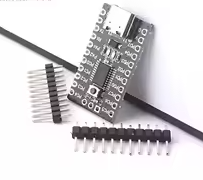
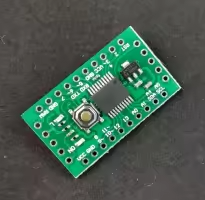
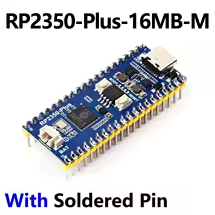
CH32V003F4P6 RISCV Core Board with TYPEC Interface
UltraLowCost 32bit RISCV Development Board
This core board is built around the CH32V003F4P6 microcontroller, featuring a 32bit RISCV2A processor running at 48MHz [citation:2]. It offers an ultralowcost entry point into RISCV development with 16KB Flash and 2KB SRAM [citation:1]. The board provides convenient TYPEC connectivity for power and development.
RISCV2A 32bit Core - Open architecture with 48MHz performance [citation:2]
Wide Voltage Support - Operates from 3.3V or 5V with industrial temp range [citation:2]
Supply voltage is 3.3V or 5V with -40°C to +85°C industrial range [citation:2]
Use WCHLinkE programmer for 1wire SWD debugging [citation:2]
GPIO pins support 5V logic - check pinout for specific pin tolerance [citation:2]
Technical Specifications
| Parameter | Value |
|---|
| Processor | QingKe RISCV2A 32bit |
| Clock Speed | 48MHz |
| Flash Memory | 16KB |
| SRAM | 2KB |
| GPIO Pins | 18 |
| ADC | 10-bit with channels |
| Communication | USART, I2C, SPI |
| Debug Interface | 1-wire SWD |
| Package | TSSOP-20 |
| Voltage | 3.3V / 5V |
= Key Features =
UltraLow Cost Affordable 32bit RISCV entry platform [citation:1]
Wide Voltage Range - 3.3V or 5V operation for versatile use [citation:1]
Industrial Temperature 40°C to +85°C for robust applications [citation:2]
1Wire Debug Interface Simple SWD programming with WCH-LinkE [citation:2]
DMA Controller 1channel general-purpose DMA [citation:2]
Rich Peripherals USART, I2C, SPI, 16bit timers, OPA [citation:2]
= Applications =
- RISC-V learning and embedded development
- Industrial automation and control
- IoT edge devices
- Consumer electronics
- Low-cost sensor systems
- Battery-powered applications
Excellent Value Full RISCV development at minimal cost
Easy to Use TYPEC interface for simple power and connection
√ Supports MounRiver Studio IDE (MRS) [citation:2]
√ Compatible with Embeetle IDE for smooth development [citation:3]
√ 96-bit unique chip ID for device identification [citation:2]
Development Setup
The board supports MounRiver Studio (MRS) IDE or Embeetle IDE for development [citation:2][citation:3]. Programming uses a WCHLinkE programmer via the 1wire SWD interface [citation:2]. Some development boards integrate the flasher/debugger directly for plugandplay convenience [citation:3].
Install MounRiver Studio (MRS) for CH32V003 series support [citation:2]
Use USB TYPE-C for power connection (5V via standard cable)
CH32V003F4P6 requires WCHLinkE programmer (not WCHLink) [citation:9]
FLASH has 16KB capacity - plan firmware size accordingly [citation:1]
Troubleshooting
Core board not responding:
- Verify TYPEC cable supports power delivery (not chargeonly)
- Check WCH-LinkE programmer SWD connection
- Ensure 3.3V or 5V supply is stable
Programming fails:
- Confirm WCHLinkE support (not original WCHLink) [citation:9]
- Verify 1-wire SWD connections are correct
- Check target voltage matches programmer setting